
Numbered Polymarket wallets whose names begin with xfm- repeatedly traded opposite sides of the same market and moved into other markets together. In MSR Decode’s saved records, 40 of 47 complete wallet pairs entered the same markets in the same order. The records support a repeatable trading routine. They leave its economic purpose unresolved. [3]
Opposite shares cover both outcomes
To understand the pattern, start with what a pair of opposite shares represents. A standard binary prediction market has two outcomes, Yes and No. If Yes wins, one Yes share pays one unit of the token backing the market and the No share pays nothing. If No wins, the reverse happens. One Yes share and one No share together cover either answer, with a combined payout of one backing unit before costs. Two wallets holding these opposite shares may therefore form a paired position rather than two separate bets on the event. That economic relationship does not establish who controls the wallets. [2]
The Anthropic market makes this distinction visible. A social-media post highlighted 18 XFM accounts in the market asking whether Anthropic’s ticker would be $ANTH. At MSR’s October 2, 2026 checkpoint, nine wallets together held 1,779.93 Yes shares. Nine corresponding wallets held exactly 1,779.93 No shares. Half were positioned on one answer and half on the other. [1]
The numbered XFM wallets in the supplied screenshot
18 account entries · displayed share counts are rounded
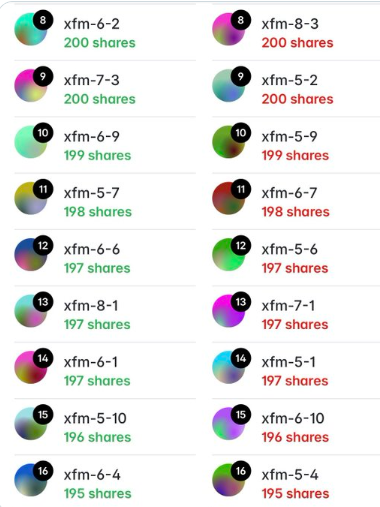
The Anthropic positions matched on both sides
October 2, 2026 checkpoint · 18 selected wallets · shares
| Outcome | Wallets | Total shares |
|---|---|---|
| Yes | 9 | 1,779.93 |
| No | 9 | 1,779.93 |
Blockchain records traced those holdings to nine transactions on June 23. Each transaction split the market’s backing token, called collateral, into matching Yes and No shares. One wallet received the Yes shares and its partner received the same number of No shares. A merge reverses that process: a matching Yes and No share can be converted back into their backing collateral. If the wallets were managed together, their equal opposite positions could offset the risk of choosing the wrong answer, although fees and other costs could still affect the combined result. [1] [2]
The same mechanism appeared repeatedly in the original 18-wallet group. MSR reviewed 117 transactions; their receipts showed collateral splits or merges and outcome-token movements involving both members of a pair. This receipt review establishes the mechanism for that subset. The wider profile review described below uses saved API activity records. [2]
One pair moved from Discord to H100 to Gold
The wallets xfm-5-10 and xfm-6-10 show how the routine worked over time. On February 13, 2026, each bought 130 shares on opposite sides of a Discord IPO market. Their recorded prices were 0.925 and 0.075 per share, adding to 1.00. Two days later, each sold 130 shares at prices of 0.897 and 0.103, again adding to 1.00. The transaction receipts recorded a split when they bought and a merge when they sold. [3]
Just 1 minute 56 seconds after the Discord sale, both wallets bought opposite positions in a market involving H100 computing prices. Four days later, they sold the H100 positions and entered a Gold market 54 seconds afterward. The sequence shows the pair repeatedly leaving one market and entering another together. It does not establish that the sale proceeds funded the next purchase. [3]
One pair moved from Discord to H100 to Gold
February 2026 · UTC · xfm-5-10 and xfm-6-10 · selected example
| Date and time | What the pair did | Recorded prices |
|---|---|---|
| Feb. 13 01:27:51 | Each bought 130 opposite Discord IPO shares. The receipt records a split. | 0.925 + 0.075 |
| Feb. 15 15:29:47 | Each sold 130 Discord shares. The receipt records a merge. | 0.897 + 0.103 |
| Feb. 15 15:31:43 | Each bought 130 opposite H100 shares, 1 minute 56 seconds after the Discord sale. | 0.90 + 0.10 |
| Feb. 19 08:15:30 | The pair sold its H100 shares, then entered Gold 54 seconds later with 190 shares each. | Gold entry: 0.98 + 0.02 |
Discord entry: 0.925 + 0.075 = 1.00
Discord exit: 0.897 + 0.103 = 1.00
130 × (1.00 − 1.00) = 0 gross combined price gain
The Discord example also explains why repeated trading need not produce a gain from the combined prices. The pair paid a total recorded price of 1.00 for each matched Yes and No share and received 1.00 when it sold. Across 130 matched shares, the gross combined price gain was zero. Fees, rewards and other payments belong in a separate calculation before drawing a conclusion about profit.
The wider sample repeated the routine
MSR’s broader review covered 97 selected XFM profiles, including 47 numbered pairs for which both partners appeared in the capture. Within 40 of those pairs, the partners entered the same markets in the same order. This matching activity supports a shared workflow within the pairs, although the records do not identify who directed it. [3]
The records also showed 579 wallet-days on which a sale from an older observed position preceded a first-observed purchase in another market. A wallet-day means one wallet’s activity on one UTC date. The median gap between the sale and the new purchase was 2.6 minutes. The timing test did not require the older position to be fully closed. “First observed” means first in the saved API rows; those records are known to omit some trades. [3]
The two members of a pair often contributed matching observations. Counting a qualifying date once per pair produced 285 pair-days among profiles with a captured partner. That count avoids presenting the two wallets’ synchronized activity as two independent trading decisions. [3]
Different pairs followed different market sequences
Matching sequences within pairs did not mean that every pair followed one fixed market list. No two different pairs in the capture had identical full market-entry sequences. Yet nine pairs entered the Anthropic market on June 23, at different stages of their observed histories. This same-day entry is consistent with a common market-selection input or common market availability. The records do not distinguish between those explanations or identify the input. [4]
Recorded prices did not support simple arbitrage
One possible reason to trade both outcomes is complete-set arbitrage: buy a matching Yes and No share for less than their one-unit backing, then collect the difference. Selling the pair for more than one unit would likewise offer a favorable gross price difference. That explanation requires a price advantage in the paired trades.
MSR tested 582 groups of equal-size paired trades in the saved API records. None had a favorable combined price: 460 showed no gross price advantage and 122 showed unfavorable pricing. These results do not support simple complete-set price arbitrage as the explanation for the tested routine. They do not measure total account profitability. [5]
None of the tested paired groups had a favorable combined price
582 equal-size paired groups · saved API records · before fees and rewards
| Result | Paired groups |
|---|---|
| No gross price advantage | 460 |
| Unfavorable combined price | 122 |
| Favorable combined price | 0 |
Rebate payments were real, but their role is unresolved
Thirteen XFM profiles received verified transfers totaling 15.6271 PUSD, corresponding with Polymarket API records labeled MAKER_REBATE. PUSD is the token unit used in these records; the transfers were not independently verified bank-dollar proceeds. The records establish that the payments occurred. The available records do not show which orders earned it, which historical formula applied or whether using separate accounts increased the reward. Without those links and a complete account reconciliation, the payments cannot explain the routine’s overall return. [6]
The activity was regular, but did not follow exact universal rules
Two other proposed explanations were an exact nine-market target and a requirement to enter one new market on every active day. Only 42 of the 97 profiles visited exactly nine markets; the observed range was 5–14. Of 937 active wallet-days, 894 had one first-observed market entry, 35 had none and eight had more than one. These exceptions rule out those exact patterns in the saved capture. [5]
Several simple explanations do not settle the purpose
Selected 97-profile capture · populations differ by test
| Possible explanation | What the records show |
|---|---|
| The pairs exploited cheap combined Yes and No prices | 582 paired groups were tested. None showed a favorable gross complete-set price. |
| Every wallet completed exactly nine markets | 42 of 97 profiles visited exactly nine. The observed range was 5–14. |
| Every active day required exactly one new market | Of 937 active wallet-days, 894 had one first-observed entry, 35 had none and eight had more than one. |
| Maker rebates explain the strategy | 15.6271 PUSD of payments was verified. The earning rule and benefit of separate accounts remain unknown. |
The trading pattern is clearer than its purpose
The evidence supports a standardized routine: paired wallets took opposite positions, sold or reduced older positions and moved into other markets together. When matching opposite positions are considered together, their exposure to the prediction can be limited even as each wallet accumulates a separate trading history. That distinction matters when interpreting a list of account holders: the number of wallets alone does not tell a reader how many independent bets the positions represent.
Separate trading histories could matter to an operator seeking participation records, account-level activity or reward eligibility. Those are hypotheses. Ordinary trading, paid liquidity, market-making work or execution for separate clients could also produce similar activity. MSR has not found an operator instruction, client ledger or historical order-level reward record that distinguishes these purposes. [5]
Ownership is a separate unresolved question. The original 18 wallets had 18 different signing-owner addresses, while some wallets across different pairs shared cash-out recipients. The shared routes support a connection in how part of the group handled money, but a common service could explain it. Different signing addresses also do not identify different people: one person can operate several keys. Neither result establishes who ultimately controlled the wallets or whether all 97 profiles belonged to one operator. No platform or wallet operator was contacted. [2]
The public records explain how the paired positions were created and how the wallets moved through markets. They leave the economic question open: what benefit made it useful to repeat this activity across separate paired accounts?